The opportunity

The work is already budgeted. It is just being spent on vinyl.

Businesses already pay for signs that curl, vinyl that lifts, repaints that close the room, and wayfinding that never quite works. Wall printing captures spend that exists today and makes it permanent. Then it adds a second market: the brick, block, textured and glass walls that stayed blank for a hundred years because nothing could print them. Here is how owners find that work, win it, and repeat it.

By Jason Ott, VP of Business Development, The Wall Printer

Last updated August 31, 2026 · Reviewed by The Wall Printer team

The thing nobody notices

Four grand of work, found by getting lost.

Jason walked into a self-storage place last year to grab something from a unit and found about four thousand dollars of work before he reached the counter. Not because the building was ugly. Because he got lost, every hallway looked the same, and the man at the counter said that happens all day. Six years in the building had made the problem invisible to its owner. That is the whole skill: walking in with fresh eyes. You already have it. You just have not been pointing it at anything.

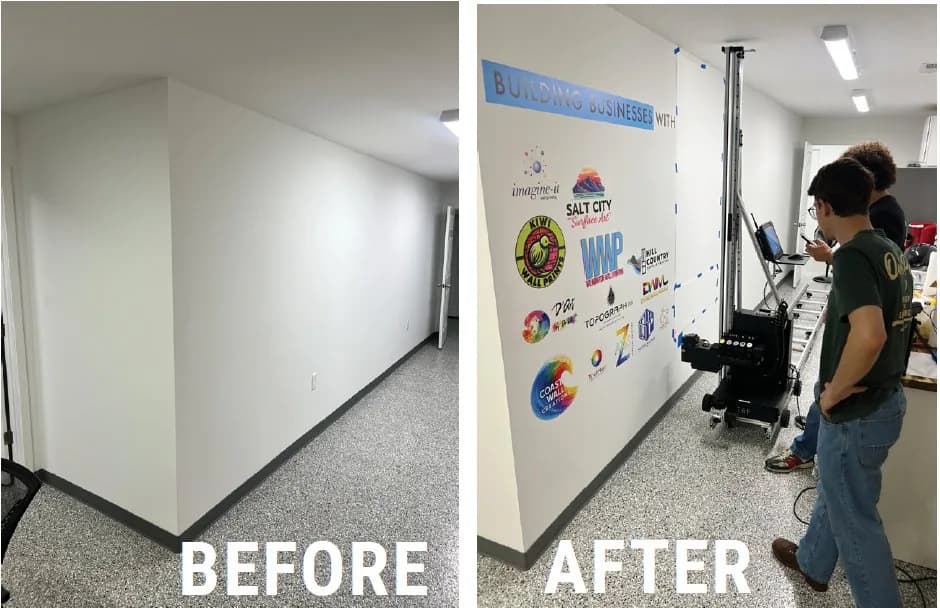
Office wall before and after a direct to surface printBefore / after
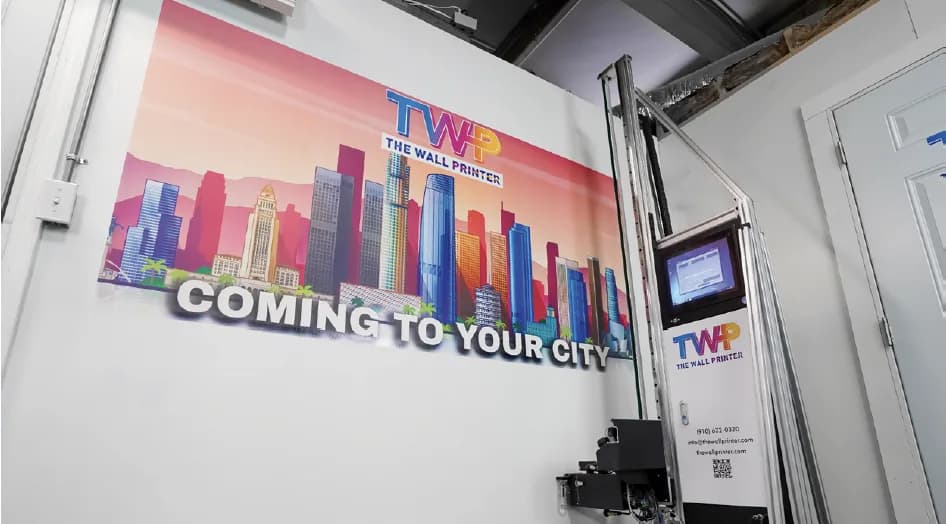
City skyline mural printed on a showroom wallShowroom
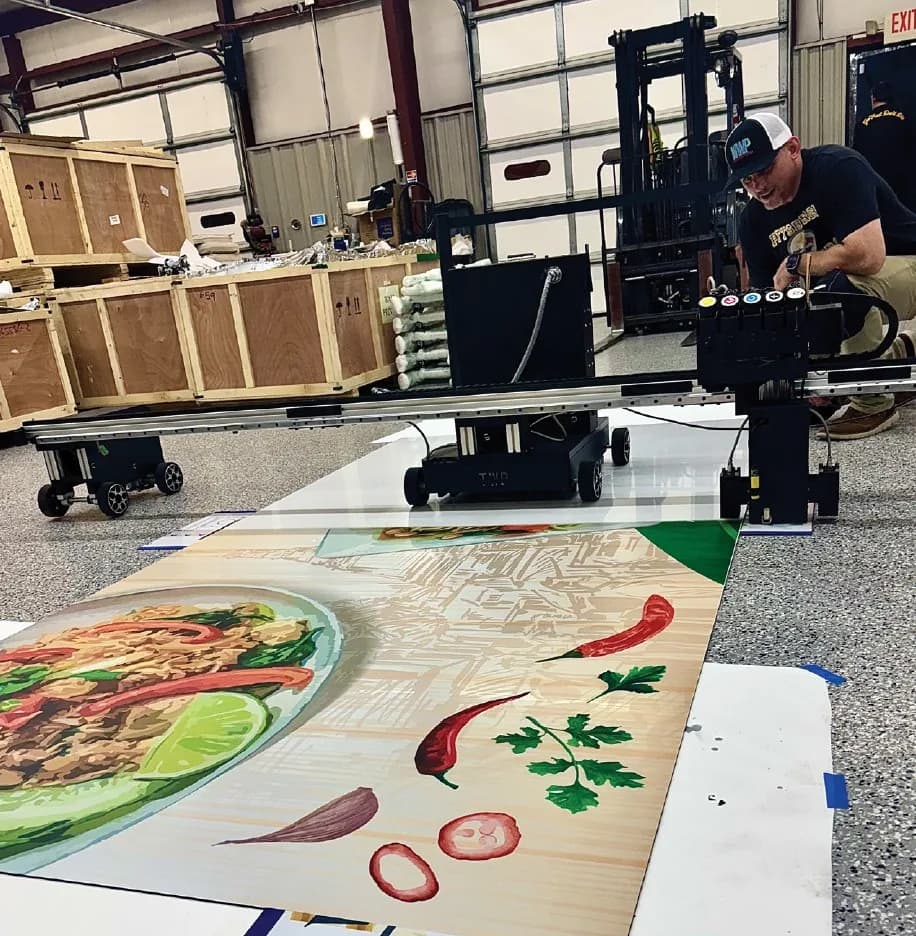
Food mural printed directly onto a floor by the FUVFloor
See it run

Never seen one work? Watch this first.

Everything on this page makes more sense once you have watched a print happen: a file on a laptop becomes finished artwork on the wall itself, while the room stays open.

Problems with money behind them

First flavor: something in the building is not working.

Operating problems already have budget attached. These are the conversations owners walk into every week.

Car washes: nothing survives in there

Water all day, brushes, chemicals. Whatever signage they hang is curling off inside a season, and repainting means shutting the tunnel down for a day. Printed into the block itself there is nothing to peel and no adhesive to fail. That signage budget already exists; it is just being spent on something that keeps dying.

Childcare and healthcare: a compliance problem

Adhesives off-gas, and flammability is a real question in a room full of two year olds. VOC free UV ink cures on contact with no adhesive at all. The same argument got these machines into hospital networks, which still surprises people.

Grocery and retail: a downtime problem

Departments rebrand constantly, and every round is a print order, a lead time, and an aisle roped off. A printed wall gets primed and redone in place, overnight, and the store never closes. The rebrand budget is already approved; you are just the faster way to spend it.

Self-storage and big buildings: a wayfinding problem

Every hallway looks the same, the unit numbers are stickers, and the counter staff give directions all day. Wayfinding printed onto the block, arrows on the floor, color coded zones: fixed permanently in an afternoon. One walk-through of a building like that can surface thousands of dollars of work.

The second flavor

The room is the marketing.

Coffee shops, taprooms, restaurants

Their whole business runs on getting photographed and not feeling like the chain down the road. The room is the marketing. Framed that way you are not quoting square footage, you are solving why nobody posts about this place.

Hotels, apartments, offices

Lobby statements, story walls, amenity spaces, photo moments. Spaces that lease faster, review better, and recruit better. Developers and designers spec this work every year and currently buy it as vinyl and paint.

The jobs nobody framed yet

A church conversation about an ordinary wall turned into printed ceiling panels, a message from above printed above the congregation. It got bigger because nobody had ever framed it that way. Framing the problem is the part you get paid for, and it never gets boring.

Who buys this work: boutique hotels, apartment communities, restaurants, breweries and taprooms, medical and corporate offices, commercial developers, designers and architects, self-storage, car washes, grocery, schools and churches. Real installations are in the portfolio.

Why this work is unclaimed

For a hundred years there were only four ways, and none of them held.

Wallpaper

Wants a flat, dry wall and lifts the moment there is humidity.

Vinyl

Sits on top of a surface instead of going into it, so it cannot hold on brick or block, and every big graphic has seams.

Stencils

Fine for a logo, useless for an image.

Hand painting

Genuinely beautiful, and forty to fifty a square foot with somebody on a ladder in the lobby for a week.

So for about a century the answer was mostly nothing, which means the work is still sitting out there. The machine is not what you sell. It is what lets you say yes: straight onto brick, block, stucco, concrete, glass and wood, with ultrasonic sensors reading the surface as it goes, and UV ink that cures on contact so the business stays open while you work. Where vinyl still genuinely wins, and where it cannot follow, is laid out honestly on the vinyl comparison page.

How owners sell it

A five step playbook, proven by one of our own.

Wilmington Wall Printing, the operation run by Ernie Fritz here in our home town, sells this work with a method they call The Wall Factor™: read the space first, print second. It works because it never starts with the machine.

01 · Discover

Learn the business before you discuss walls. What they do, who they serve, what the owner is annoyed about.

02 · Assess

Read the space against an eight point checklist: entry, reception, hallways, windows, floors, facade, the wall that bugs them, the spot where a customer would take a photo.

03 · Vision

A custom concept and a digital mockup. Show, do not tell. The mockup closes more jobs than any pitch.

04 · Transform

Design, produce, and install with minimal disruption. UV cures on contact, no smell, and the business stays open while you work.

05 · Amplify

Photos, social, and a reopening push. Every finished wall sells the next one, and the crowd that gathers while you print is a live demo you are being paid to run.

Ernie takes reference calls: 910.319.9359, Wilmington Wall Printing. Call with nobody from The Wall Printer on the line and ask how the jobs actually land.

And Amplify is not theory. When the work is good, it travels further than you pitched it. These owners watched their walls show up on national television.

The multiplier

It can do it again.

Same file, same result, next month, different city. Fix the wayfinding problem for one storage facility and you did not do a job, you built something that runs at their other eleven locations. Because the quality lives in the file instead of in your hands, you can teach somebody to run the machine while you go find the next problem. That is the difference between buying a job and building a company, and it is why facilities and multi-location operators are such a natural fit for this business. Two and three machine fleet packages are priced lower per unit. Ask and we will put the number in writing. Model it yourself, one machine or six, on the calculator page; the machines and everything in the crate are priced on the pricing page.

Questions

Asked the way buyers type them.

Where does wall printing work actually come from?

From budgets that already exist. Businesses already pay for signs that curl, vinyl that lifts, repaints that close the room, and wayfinding packages that never quite work. Wall printing captures that existing spend with a permanent result, and then adds the jobs nobody could do before: brick, block, texture, glass, and floors.

Do businesses really have budget for this?

Yes, and that is the point. A car wash re-signs every season, a grocery chain rebrands departments on a calendar, a hotel refreshes on a cycle, and facilities teams write checks to outside graphics vendors every year. The conversation is not about creating a new budget line; it is about redirecting one that exists to something that does not peel, fade, or close the business.

What replaces printed vinyl spend?

Seamless large format walls, anything on brick, stucco, concrete or texture where adhesive fails, graphics in wet or high traffic environments, and multi-location packages where one file prints identically in every city. Where vinyl genuinely wins, small flat temporary graphics, we say so, at highmarginbusiness.com/wall-printing-vs-vinyl.

Is this decorating?

The strongest jobs are not. They are operating problems: customers getting lost, signage dying in a car wash, compliance in a childcare room, downtime in a grocery aisle. Operating problems already have money behind them, and that is a much better conversation to walk into.

What does it cost to start, all in?

The machine runs $39,995 to $44,995 complete, with training, starter ink, cases, warranty and lifetime support. Starting from scratch, budget roughly $20,000 to $25,000 on top for a van or trailer, insurance, an LLC, a design laptop, ink inventory and real marketing. An existing business with a van and a client list spends close to nothing past the machine, which is why print shops and contractors ramp fastest.

Can the work repeat across locations?

That is the piece that turns good work into a company. The quality lives in the file, so the wayfinding you fix for one storage facility runs identically at their other eleven locations, and you can teach somebody to run the machine while you go find the next problem. Two and three machine fleet packages are priced lower per unit for exactly this path.
The longer look

Could wall printing be your next venture?

If the idea has not let go of you by this point in the page, this is the fuller conversation: the work, the customers, and what owning one is actually like.

Try the skill

Go somewhere this week and look up.

You will see what we mean. Then text us what you found and where you are, and we will tell you what that wall is worth. Wilmington, North Carolina.

Text us at 910-679-0962

Text "Get Started" and tell us your city. A real person answers, usually the same business day. Prefer to talk? Call 910.632.0320. North and South America.